Skip to content
Ó Baoighill
Gaeilge English
Menu

Historical Records

Original records and early printed sources that mention the name, with transcriptions and links to the archives that hold them.

Only genuine records are shown, with their rights and a link to the archive. Transcriptions are kept apart from explanation.

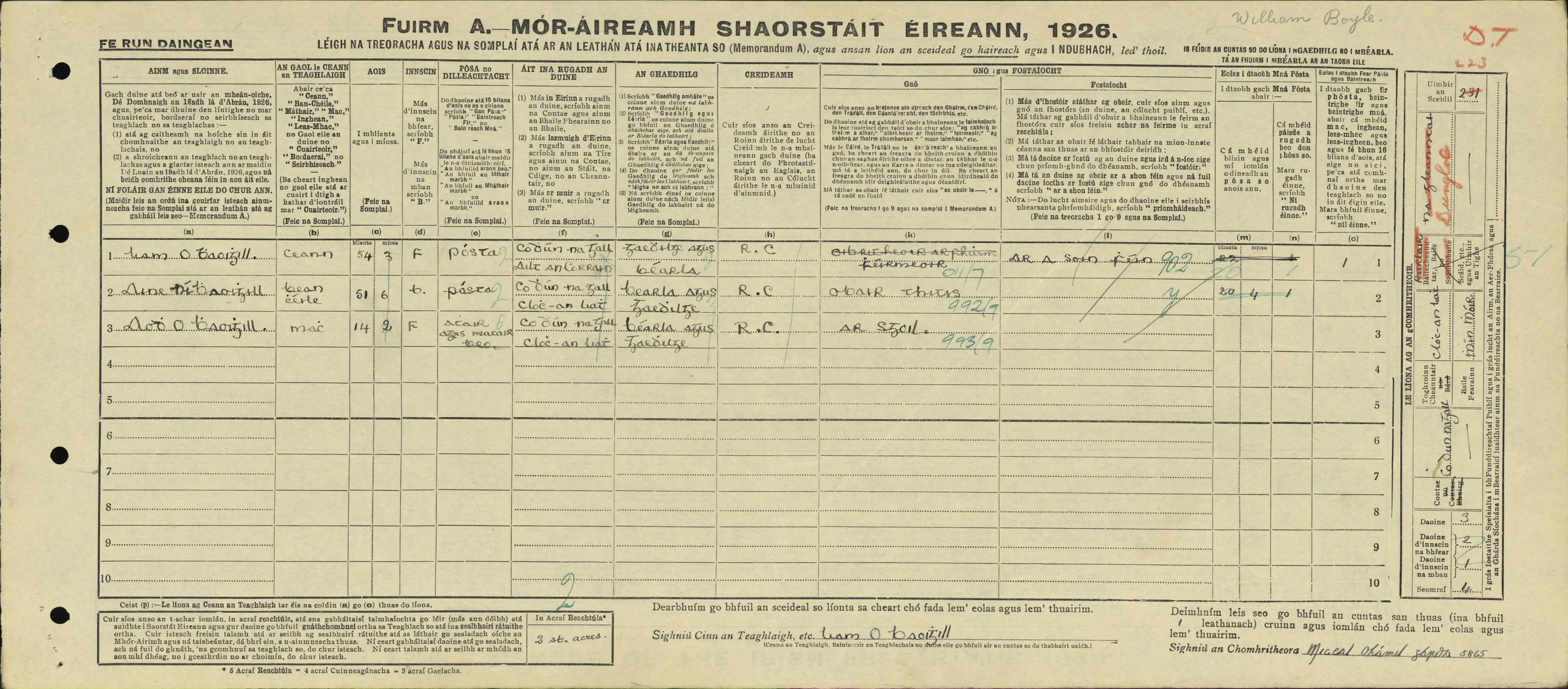
An Irish-language 1926 census form handwritten in Gaelic script, with Ó Baoighill names and a pencil note “William Boyle”

A census form in Irish, Meenmore, 1926

100%Original
An Irish-language 1926 census form handwritten in Gaelic script, with Ó Baoighill names and a pencil note “William Boyle”
Held by:
National Archives of Ireland
Rights:
This work includes content from records of the 1926 Census of Ireland, made available by the National Archives of Ireland under the Creative Commons Attribution 4.0 International (CC BY 4.0) licence. The image has been resized and converted.

1926

A census form in Irish, Meenmore, 1926

Transcription: Names and relationships only; the second surname is unclear in the original (a letter is written over).
Fuirm A. Mór-Áireamh Shaorstáit Éireann, 1926 1. Liam Ó Baoiġill — Ceann — 54 2. Áine …aoiġill — Bean chéile — 51 3. Aodh Ó Baoiġill — Mac — 14 [peann luaidhe / pencil:] William Boyle
Why it matters

The head of household wrote his name in Irish, Liam Ó Baoighill, on the Irish-language form. At the top of the same form a clerk pencilled “William Boyle”: one man under both names on a single sheet.57,37

Original (nationalarchives.ie)

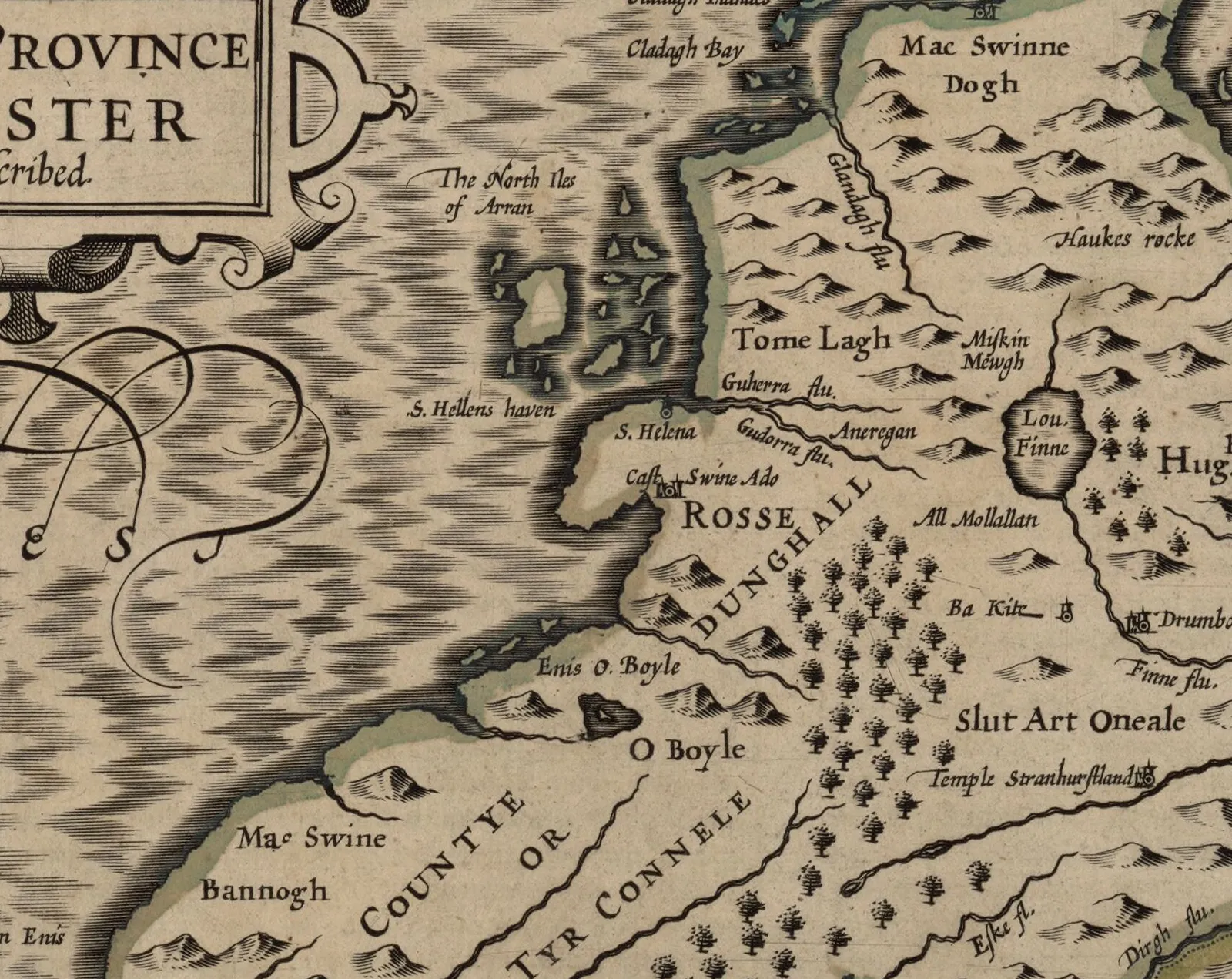
Engraved map of west Donegal with the labels “Enis O. Boyle”, “O Boyle”, “Rosse” and “Dunghall”

John Speed: “O Boyle” on the map of Ulster, 1610

100%Original
Engraved map of west Donegal with the labels “Enis O. Boyle”, “O Boyle”, “Rosse” and “Dunghall”
Held by:
Bibliothèque nationale de France (Gallica), via Wikimedia Commons
Rights:
Public domain. Cropped and resized.

1610

John Speed: “O Boyle” on the map of Ulster, 1610

Transcription: Labels legible in this part of the map.
Enis O. Boyle / O Boyle / ROSSE / DUNGHALL / S. Helena / Cast. Swine Ado / Countye or Tyr Connele

Why it matters

On Speed’s map, made on the eve of the Plantation, the territory is marked with the family’s own name, “O Boyle”, rather than a barony name.17

Original (commons.wikimedia.org)Show on the map

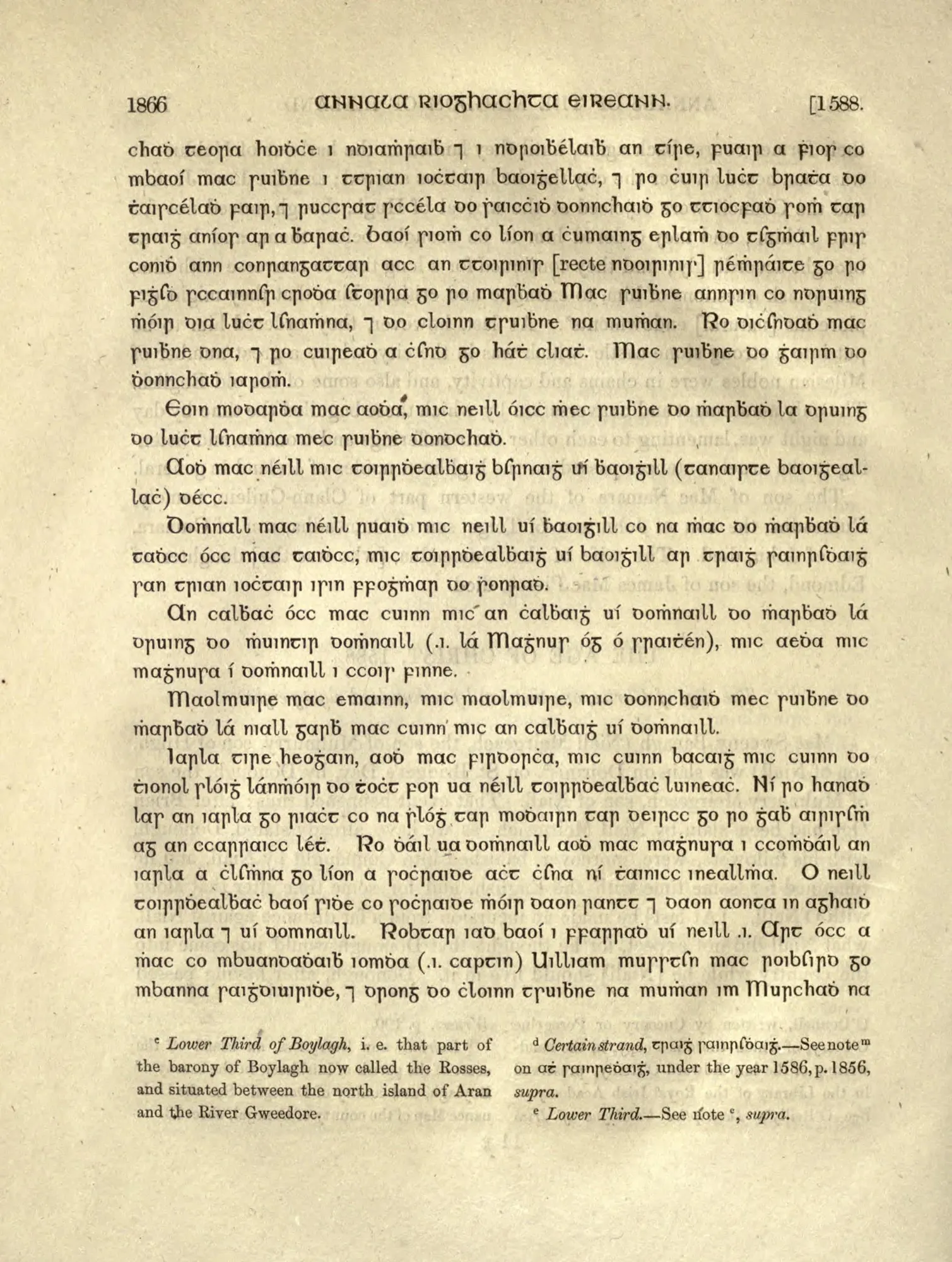
A page of the Irish text with O’Donovan’s footnotes on Boylagh

O’Donovan: “Boylagh now called the Rosses”

100%Original
A page of the Irish text with O’Donovan’s footnotes on Boylagh
Held by:
Internet Archive (University of Toronto)
Rights:
Public domain. Resized.

1588 / 1856

O’Donovan: “Boylagh now called the Rosses”

Transcription: The Annals’ text and O’Donovan’s footnote.
Aodh mac Néill mic Toirrdhealbhaigh bhfionnaigh uí Bhaoighill (tanaiste Baoigheallach) d'écc … “Lower Third of Boylagh, i.e. that part of the barony of Boylagh now called the Rosses …”

Why it matters

The death of the Tanist of Boylagh in 1588, and O’Donovan’s nineteenth-century explanation that the “Lower Third of Boylagh” was the Rosses. The footnote is his interpretation, not part of the Annals.3,44

Original (archive.org)Show on the map

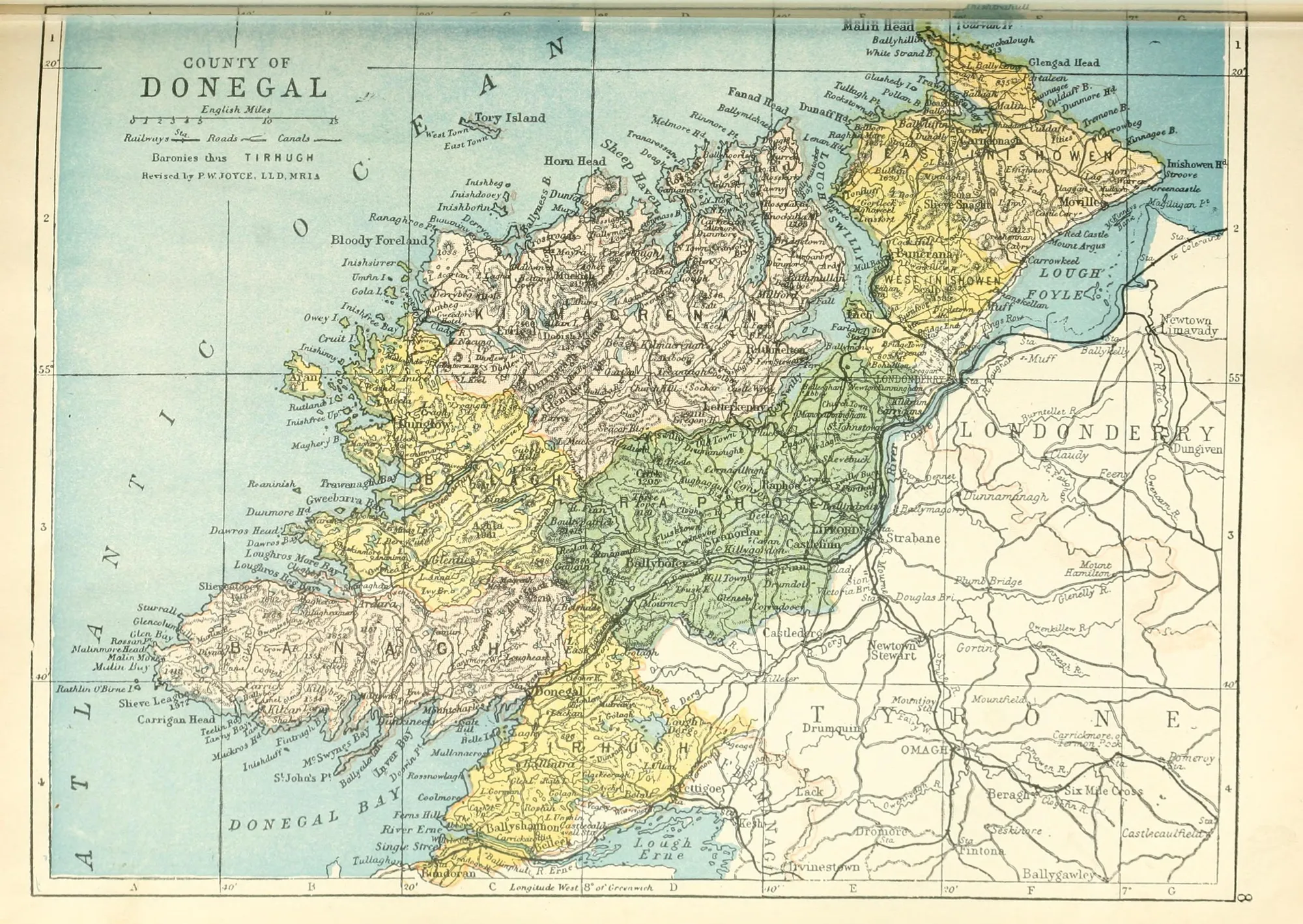
Coloured map of the baronies of Donegal showing BOYLAGH, Dunglow and Gweebarra Bay

P. W. Joyce: the baronies of Donegal, 1900

100%Original
Coloured map of the baronies of Donegal showing BOYLAGH, Dunglow and Gweebarra Bay
Held by:
Wikimedia Commons, from the Atlas and Cyclopedia of Ireland
Rights:
Public domain. Resized.

1900

P. W. Joyce: the baronies of Donegal, 1900

Why it matters

The barony of Boylagh as it stood after 1791, between Gweedore and Banagh.12

Original (commons.wikimedia.org)Show on the map

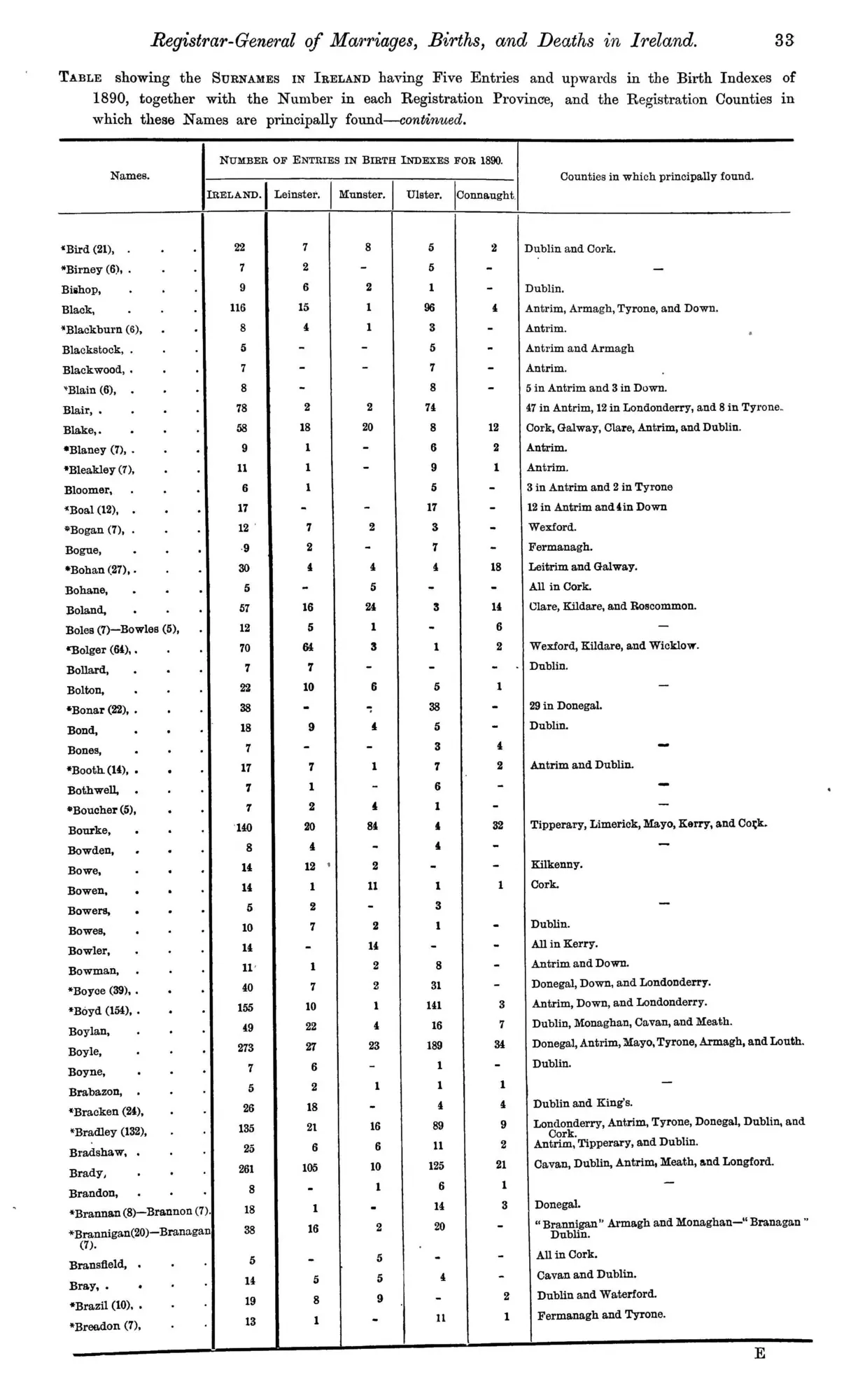
A printed table of surnames with numbers of births by province

Matheson: Boyle in the birth indexes, 1890

100%Original
A printed table of surnames with numbers of births by province
Held by:
Internet Archive (Cornell University Library)
Rights:
Public domain. Resized.

1894

Matheson: Boyle in the birth indexes, 1890

Transcription
Boyle — 273 — Leinster 27, Munster 23, Ulster 189, Connaught 34 — Donegal, Antrim, Mayo, Tyrone, Armagh, and Louth.

Why it matters

The earliest official count of the name: 273 births in 1890, most of them in Ulster.58

Original (archive.org)

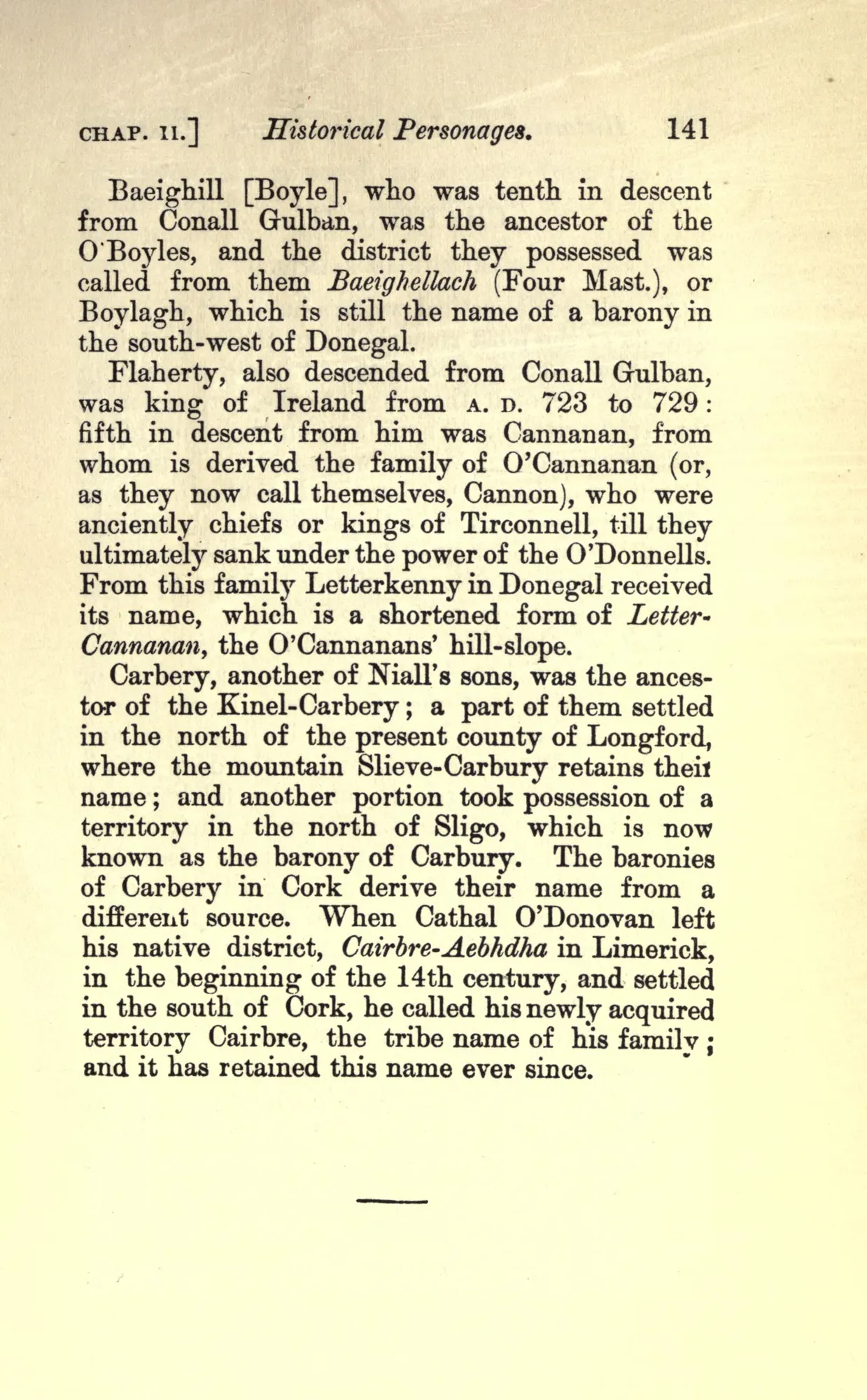
A printed page explaining the name Boylagh

Joyce: “Baeighellach, or Boylagh”

100%Original
A printed page explaining the name Boylagh
Held by:
Internet Archive (University of Toronto)
Rights:
Public domain. Resized.

1869

Joyce: “Baeighellach, or Boylagh”

Transcription
Baeighill [Boyle], who was tenth in descent from Conall Gulban, was the ancestor of the O'Boyles, and the district they possessed was called from them Baeighellach (Four Mast.), or Boylagh, which is still the name of a barony in the south-west of Donegal.

Why it matters

Joyce’s classic explanation of the name Boylagh. “Tenth in descent from Conall Gulban” is genealogical tradition, not established fact.21Scholarly interpretation

Original (archive.org)Show on the map

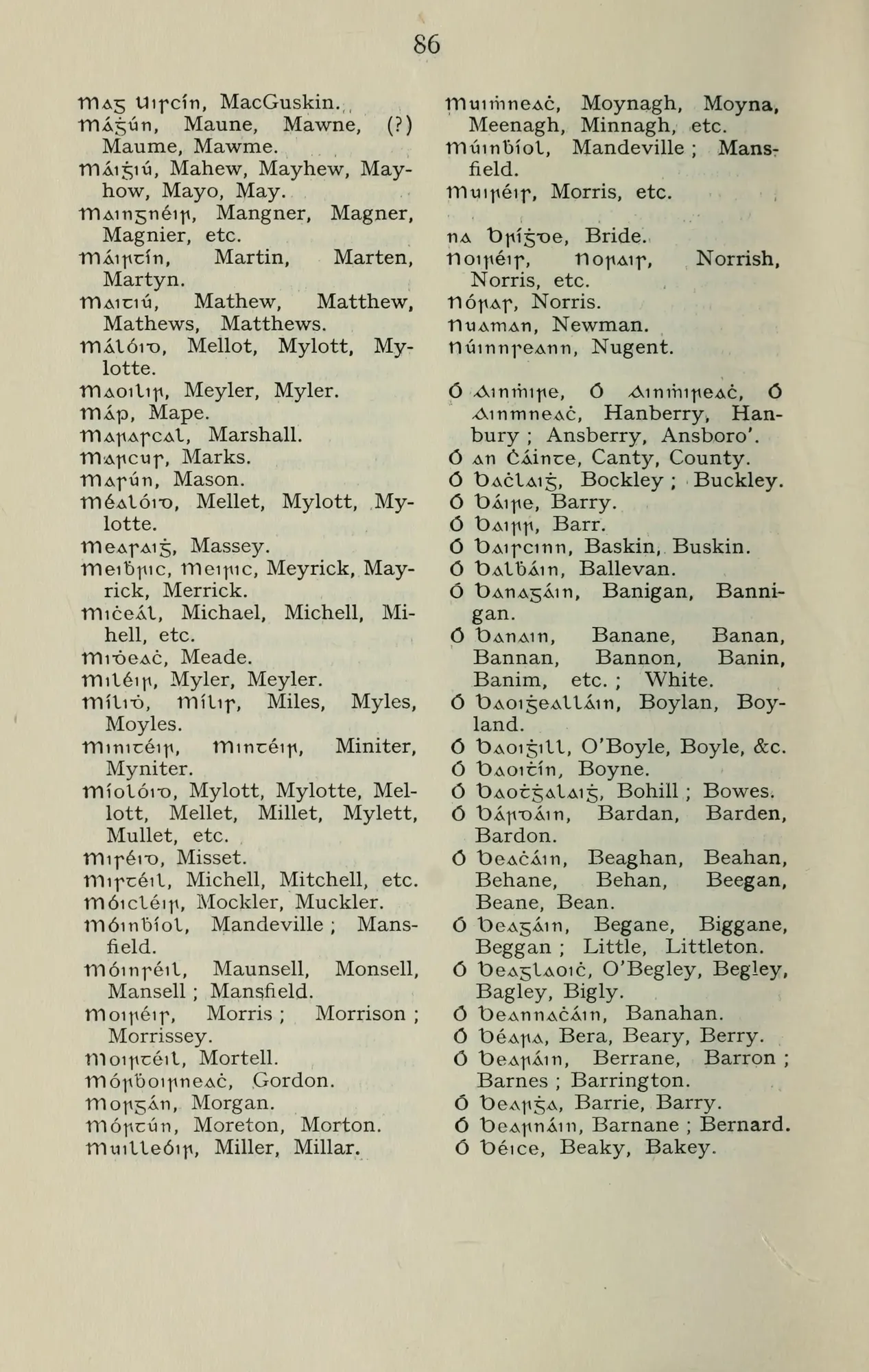
A printed page of surnames in Gaelic type, including Ó Baoighill

Woulfe, Irish Names and Surnames: Ó Baoighill

100%Original
A printed page of surnames in Gaelic type, including Ó Baoighill
Held by:
Online text at Library Ireland
Rights:
Public domain (the author died in 1933). Image: Internet Archive, from the 1922 Gill edition.

1923

Woulfe, Irish Names and Surnames: Ó Baoighill

Transcription: The opening of the entry.
Ó BAOIGHILL—I—O'Boyle, Boyle, &c.; 'descendant of Baoigheall' (probably for baoithgheall, vain-pledge)

Why it matters

The reference work that fixed the form Ó Baoighill for the twentieth century, with its account of Críoch Bhaoigheallach.18

Original (libraryireland.com)

No image can be reproduced here; follow the link to see the original.

Held by:
Trinity College Dublin (manuscript); text at CELT
Rights:
A short passage quoted from the CELT digital edition (University College Cork), with citation.

1099

Annals of Ulster: Caencomrac Ua Baighill

Transcription
Caencomrac H. Baighill do ghabail epscoboiti Arda Macha dia Domnaigh Cengcigis.
Translation by this site

Caencomrac Ua Baighill took the bishopric of Armagh on Whit Sunday.

Why it matters

The oldest mention of the surname found, in the Middle Irish form “H. Baighill” (Ua Baighill). His link to Tír Chonaill is not known.8

Original (celt.ucc.ie)

No image can be reproduced here; follow the link to see the original.

Held by:
Royal Irish Academy and others (manuscripts); O’Donovan’s edition at CELT
Rights:
A short passage quoted from the CELT digital edition (University College Cork), with citation.

1247

Annals of the Four Masters: head chieftain of the Three Tuaths

Transcription
an Cammuinélach Ua Baoighill priomh-taoiseach na t-Trí t-Tuath
John O’Donovan (1848–51)

the Cammhuinealach [Wry-necked] O’Boyle, the head Chieftain of the Three Tuathas

Why it matters

The first time an Ó Baoighill is named as chief of a named territory.2

Original (celt.ucc.ie)Show on the map

No image can be reproduced here; follow the link to see the original.

Held by:
Royal Irish Academy and others (manuscripts); text at CELT
Rights:
A short passage quoted from the CELT digital edition (University College Cork), with citation.

1611

Annals of the Four Masters: the bishop’s death

Transcription
Niall Ó Buidhill epscop Rathaboth do écc i n-Glionn Eidhnighe an seiseadh Februari, & a adhnacal i n-Inis Caoil.
John O’Donovan (1848–51)

Niall O’Boyle, Bishop of Raphoe, died at Gleann-Eidhnighe, on the 6th of February, and was interred at Inis-Caoil.

Why it matters

An unusual spelling of the surname, “Ó Buidhill”, and a direct link to Inishkeel in Boylagh.4

Original (celt.ucc.ie)Show on the map

No image can be reproduced here; follow the link to see the original.

Held by:
Placenames Database of Ireland (logainm.ie)
Rights:
Irish-language placename data by Logainm © Government of Ireland and licensed under CC BY 4.0.

1641–1955

Croich Uí Bhaoill: the historical forms

Transcription: As listed by logainm.ie.
1641 Myntro-iboill (Inq.) 1789 Croweyboyle (map, cited in OS Name Books) 1835 Croeyboyle (OS Name Books) 1835 Croich Uí Bhaoighill (O’Donovan) 1952 Croich Uí Bhaoighill (Ó Domhnaill, Na Glúnta Rosannacha) 1955 anoir sliabh Chroch Uí Bhaoighill (Máire, An Clár is an Fhoireann)

Why it matters

Three centuries of spellings for one placename, from Myntro-iboill to Croich Uí Bhaoill. logainm.ie explains the name as “the gallows of Ó Baoill”.1

Original (logainm.ie)Show on the map

No image can be reproduced here; follow the link to see the original.

Held by:
Trinity College Dublin, MS 839
Rights:
View at 1641.tcd.ie; no image is reproduced here.

1642–43

1641 depositions: “Turloghe Roe ô Bojle of Boilogh”

Transcription: Deposition of James Kenedy, 4 March 1643.
Turloghe Roe ô Bojle of Boilogh Esquire is another dangerous Rebell …

Why it matters

A telling spelling, “ô Bojle of Boilogh”, in a clerk’s hand in the middle of the war. The depositions are allegations by witnesses, not proven facts.11

Original (1641.tcd.ie)Show on the map

No image can be reproduced here; follow the link to see the original.

Held by:
Royal Irish Academy, Doegen Records
Rights:
Listen at doegen.ie; the audio is not reproduced here.

1928–31

Doegen recording: “Feardhomhain”

Why it matters

The voice of Domhnall Ó Baoighill of An Chlasaidh, Doochary, telling a tale in Donegal Irish.6

Original (doegen.ie)